Quick Summary
Track surface specifications are the written, measurable requirements that define what a running track must be built from, how it must perform, and how it must be tested before acceptance. A complete specification covers material composition, layer thickness, dimensional tolerances, performance criteria, and acceptance testing.
- Four areas to cover: surface system, dimensions and lane layout, performance characteristics, and testing and acceptance.
- State minimum surface thickness at any point, not an average, because thin spots wear through first.
- Require binder-to-granule ratio documentation and a retained sample taken at installation.
- Set compaction of the base as a percentage of maximum dry density, with testing at a stated frequency.
- Measure curves and transition zones, not just straight sections, when checking lane width and slope.
Table of Contents
- What Athletic Track Surface Specifications Cover
- Running Track Surface Materials: Natural, All-Weather, and Synthetic Options
- Surface System Layers and Construction Methods
- Polyurethane Running Track Specifications: Thickness, Density, and Testing
- Track Dimensions, Lane Widths, and Layout Requirements
- Performance, Traction, Friction, and Rebound Criteria
- Athletic Track Durability and Lifespan by Surface Type
- Running Track Maintenance Requirements and Lifecycle Planning
- Requesting a Free Assessment for Your Track Specification
- Frequently Asked Questions
What Athletic Track Surface Specifications Cover
Last Updated: November 1, 2026
Athletic track surface specifications are the written, measurable requirements that define what a running track must be built from, how it must perform, and how it must be tested before acceptance. A complete specification sets out material composition, layer thickness, dimensional tolerances, performance criteria, and the standards each element must meet.
For facilities managers, athletic directors, and procurement officers, the specification is the document that protects the investment. It tells contractors exactly what to deliver and gives the owner a basis for accepting or rejecting the finished work. This guide explains the parts of a specification that matter most for K-12 districts, colleges, and parks departments in the United States.
Most specifications cover four areas: the surface system (base, binder, and top layer), the dimensions and lane layout, the performance characteristics such as traction, friction, and rebound, and the testing and acceptance procedures. Each area has its own tolerances. A track that meets the surface requirements but falls outside lane-width tolerances can still fail an inspection, which is why reviewing all four areas together matters.
Many bid packages refer to recognized standards rather than restating every requirement. Common references in the industry include World Athletics certification for competition-grade surfaces. A reference to a standard only helps if the reader knows what it covers, so the sections that follow explain how each requirement is measured and what a reasonable tolerance looks like.
Running Track Surface Materials: Natural, All-Weather, and Synthetic Options
Running track surfaces fall into three broad families: natural surfaces such as cinder, clay, and grass; all-weather surfaces built from a porous base and a binder; and prefabricated or poured-in-place synthetic surfaces. Each family trades cost against durability, maintenance, and performance. Natural surfaces cost the least to install but require the most upkeep and close much of the year in wet climates. Synthetic systems cost more up front and deliver consistent performance across seasons.

Specifications for this category should name the surface type explicitly and state the minimum performance the surface must reach. A bid that says only “all-weather track” leaves too much room for interpretation. The table below shows the specification levers that matter most for each family.
| Surface family | Typical base | Top layer | Key specification levers |
|---|---|---|---|
| Natural (cinder, clay, grass) | Native soil or amended subgrade | None or loose aggregate | Gradation, moisture content, crown and slope, annual regrading |
| All-weather porous | Open-graded aggregate | Binder-bound rubber or resin | Permeability rate, binder ratio, aggregate gradation |
| Synthetic poured-in-place | Asphalt or concrete | Polyurethane binder with SBR or EPDM granules | Layer thickness, binder-to-granule ratio, cure time |
| Synthetic prefabricated | Asphalt or concrete | Factory-made roll or tile | Adhesive type, seam treatment, roll thickness tolerance |
Rubber, SBR, and EPDM Components
Most modern synthetic tracks use a rubber-based binder or top layer. Styrene-butadiene rubber (SBR) is common in poured-in-place and granule systems, while ethylene propylene diene monomer (EPDM) is often used in prefabricated rolls and in some top layers because of its weather and UV resistance. The specification should state which rubber is used, the proportion of recycled content if any, and the granule size.
Granule size and binder ratio influence both resilience and durability. Specifiers commonly require documentation of the binder-to-granule ratio from the manufacturer so the installed product can be checked against the approved submittal. A common pattern is to require a binder content within a stated percentage of the approved mix design, verified by a retained sample taken at the time of installation. EPDM top layers are frequently specified where color retention and UV stability matter, while SBR is often chosen for cost-sensitive projects.
Latex, Asphalt, and Granular Base Materials
Latex and asphalt appear mainly in the base or intermediate layers of track construction. An asphalt base provides structural support and drainage paths, and a granular base, typically crushed stone graded to a specified size, supports the asphalt or porous layers above. Specifications should set gradation limits for the granular base and minimum compaction levels, since a poorly compacted base is a common reason surfaces crack or settle.
A practical specification will state the compaction requirement as a percentage of maximum dry density determined by a standard test method, and will require density testing at a stated frequency, for example, one test per specified area of base. Asphalt base thickness is usually specified as a minimum compacted depth, with mix design submitted for approval before paving. Where a porous all-weather system is specified, the specification should also state the required permeability rate so the base and surface drain as a system rather than as separate layers.
Ask bidders to submit mix designs, gradation reports, and compaction test results as part of the bid, not after award. Comparing submittals side by side is the fastest way to separate a genuinely specified surface from a generic “all-weather” claim.
Surface System Layers and Construction Methods
A track is a layered system, and each layer has a job. The subgrade must be prepared and compacted, the base layer carries structural load and manages water, and the top layer provides the running surface, traction, and color. Specifications typically list the thickness of each layer, the materials allowed, and the compaction or curing criteria that must be met before the next layer goes down.
Construction methods matter as much as materials. Poured-in-place systems are mixed and applied on site, so the specification should control mixing temperature, application thickness, and curing time. Prefabricated systems are manufactured in rolls or tiles and bonded to the base, so the specification should cover adhesive type, seam treatment, and bonding procedure. Either way, the contract should require a written installation plan that the owner can review before work starts.
Polyurethane Running Track Specifications: Thickness, Density, and Testing
Polyurethane is widely used as a binder and as a full top-layer system, and its specifications are among the most detailed in a track bid. Typical requirements address total surface thickness, density of the cured material, and the test methods used to confirm performance after installation.
Surface thickness is usually specified as a minimum at any point, not an average, because thin spots wear through first. Density and hardness are measured on cured samples, and tensile strength and elongation tests show whether the material can flex without tearing. Owners should ask for the test results from the manufacturer’s laboratory and, where appropriate, require a site sample test before final acceptance.
Keep in mind that a polyurethane system’s performance depends on the base beneath it. A thick, well-bonded top layer over a poor base will still fail early.
Track Dimensions, Lane Widths, and Layout Requirements
Dimensional requirements determine whether a track can host sanctioned competition and whether it fits the site. The standard 400-meter oval has an inside lane length and lane widths set by competition rules, and most specifications require lanes to be within a narrow tolerance of the nominal width, often a fraction of a centimeter.
A specification should state each dimension as a nominal value plus an allowable tolerance, and should name the measurement method. The checklist below covers the dimensional items most often tested at handover.
| Item | What to specify | How it is typically checked |
|---|---|---|
| Lane width | Nominal width with a stated tolerance | Steel tape at multiple stations along each lane |
| Inside lane length | 400 m nominal measured along the measure line | Survey or calibrated measuring wheel |
| Curve radius | Design radius with tolerance | Survey against the site plan |
| Transverse slope | Design slope with allowable deviation | Digital level or survey at cross-sections |
| Longitudinal slope | Maximum allowable grade along the running direction | Survey at intervals along each straight and curve |
| Surface evenness | Maximum deviation under a straightedge over a stated length | Straightedge and wedge at grid points |
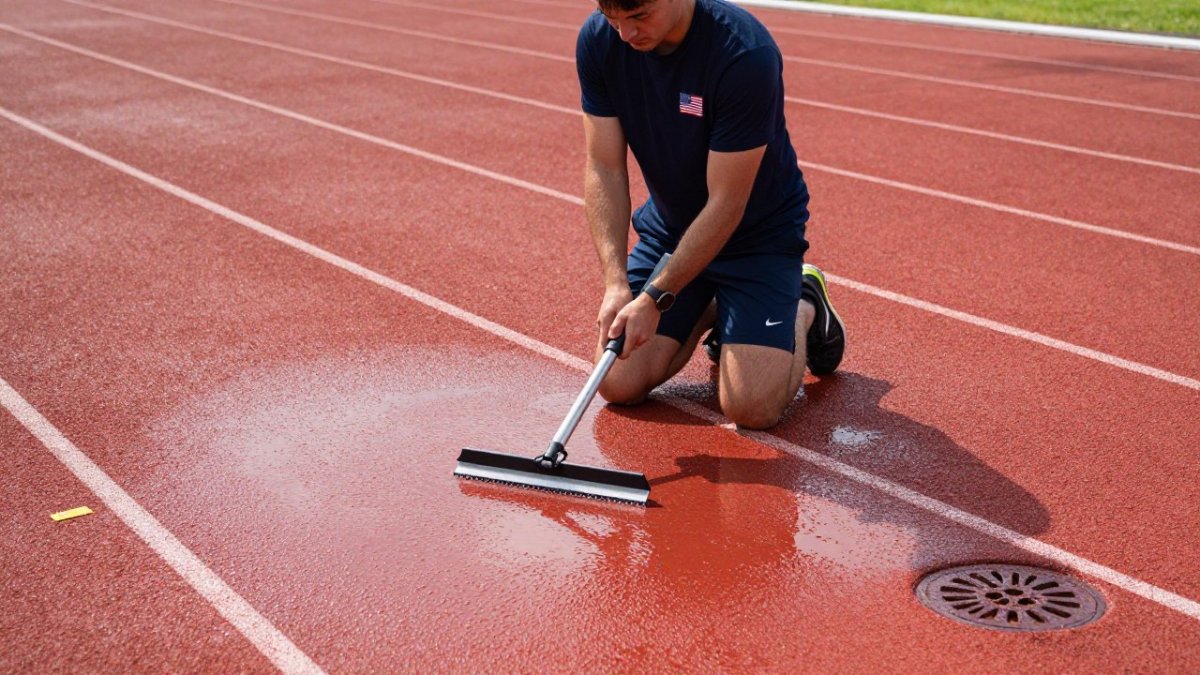
Slope and crown deserve close attention. The track should have a controlled transverse slope to drain water toward the infield, and the specification should state the allowable deviation from that design slope. Measure the finished surface against the survey grade. A track that drains poorly will hold water on the lanes, and that condition shortens the life of both the surface and the base.
Surface evenness is the dimensional requirement most often skipped in bid documents and most often disputed at handover. A specification that sets a maximum deviation under a straightedge, and states how many measurements are taken and where, gives the owner an objective basis for acceptance. Without it, a surface that looks flat can still fail an athlete’s stride.
Layout should be confirmed against the site plan before construction, including the placement of the start and finish lines, the field events inside the oval, and any future expansion.
Do not accept a dimensional survey performed only at the center of each straight. Curves and transition zones are where lane-width and slope errors concentrate, so require measurement points through the curves as well.
Performance, Traction, Friction, and Rebound Criteria
Performance criteria describe how the surface behaves under athletes. Traction is the grip a shoe gets on the surface, friction affects how the surface feels underfoot, and rebound describes how much energy the surface returns with each stride. Too little traction causes slipping and can cause injuries; too much can stress joints. Rebound that is too high or too low affects running economy and comfort.
Specifications usually set acceptable ranges for these measures and name the test method used to verify them, such as a standardized impact or traction test. The owner should ask whether the test is performed on the finished installation, how many test points are required, and what happens if the results fall outside the range. A specification without a test method leaves no way to check compliance.
Surface uniformity matters too. A surface that performs well in one spot and poorly in another creates an uneven training environment, so the specification should require consistency across the full track area.
Athletic Track Durability and Lifespan by Surface Type
Lifespan varies widely by surface type, climate, and maintenance. Natural surfaces such as cinder and clay often need annual regrading and frequent repair. Synthetic systems commonly last many years when properly installed and maintained, but the exact figure depends on use, weather exposure, and base quality. Any lifespan claim in a bid should be backed by manufacturer documentation or documented field experience, not marketing language.
Durability specifications should cover resistance to UV exposure, freeze-thaw cycles, standing water, and heavy use. Ask for the warranty terms in writing, including what the warranty covers, how long it lasts, and what maintenance the owner must perform to keep it valid. A warranty that requires unrealistic upkeep may not be worth much.
Resurfacing can extend the life of an existing track when the base is sound. A thorough inspection should determine whether the existing base can support a new top layer or whether reconstruction is needed.
Running Track Maintenance Requirements and Lifecycle Planning
A track specification should include a maintenance plan, because maintenance decisions made early affect cost for decades. Routine tasks include cleaning debris, inspecting for cracks and loose seams, clearing drainage paths, and addressing small repairs before they spread. Periodic tasks include re-striping lanes and checking surface performance against the original acceptance criteria.
Lifecycle planning compares the cost of the initial installation against annual upkeep and the expected replacement or resurfacing date. A lower-cost surface with high maintenance needs can cost more over twenty years than a higher-cost surface that needs little attention. For budget-constrained school boards and parks departments, a simple schedule showing expected inspection dates, likely repair windows, and the estimated timing of resurfacing makes the long-term cost visible before the contract is signed. Pricing for any specific product or service depends on quantity, schedule, and site conditions, so request a quote for your facility from TDRATHLETICS.
Requesting a Free Assessment for Your Track Specification
If your district, campus, or municipality is planning a new track or evaluating an existing one, the most useful first step is an assessment of the current surface and the site. TDRATHLETICS offers a free assessment to help you determine whether your track needs resurfacing, restoration, or full replacement, and to help you define a specification that fits your budget and schedule. Our recommendations focus on what is right for your facility. GET A FREE ASSESSMENT to start the conversation.
Frequently Asked Questions
What are the standard specifications for an athletic track surface?
Standard specifications for an athletic track surface cover the surface system layers, overall thickness, lane widths, slope and flatness tolerances, traction and rebound performance, and durability under load and weather. Specifications are typically tied to recognized standards such as those from World Athletics for competition tracks. Owners should request written specifications from any contractor so that delivered work can be measured against them at acceptance. TDRATHLETICS offers a free assessment for your facility.
What materials are used to make running track surfaces?
Running track surfaces are commonly made from natural materials such as cinder, clay, or grass, all-weather mixes, and synthetic systems built from rubber granules bound with polyurethane or other binders. Synthetic tracks usually combine a base layer of asphalt or a granular base with a top layer of rubber-based material. Each material has different traction, drainage, maintenance, and lifespan characteristics, so the right choice depends on climate, budget, and how heavily the track will be used.
What is the difference between polyurethane and rubber running track surfaces?
Rubber-based tracks, often using SBR or EPDM granules, are generally lower in initial cost but may show more wear and color fading over time. Polyurethane systems bind the granules with a polyurethane resin, which typically gives a more uniform surface, better weather resistance, and a longer service life. The binder choice affects rebound, surface firmness, and maintenance needs, so specifications should state the binder type explicitly rather than just the rubber content.
How thick should an athletic track surface be?
The exact thickness depends on the surface system, the intended use, and the base condition, so the specification should state thickness for each layer and the tolerance allowed at acceptance. Ask for core-sample results to verify installed thickness.
How long does an athletic track surface last?
Natural surfaces such as cinder or clay typically require more frequent attention, and the expected life of a synthetic track depends on the base condition, drainage, climate, and maintenance. Actual lifespan depends on the base condition, drainage, climate, maintenance practices, and frequency of use. Regular inspection and timely crack and drainage repairs usually extend service life. Treat these figures as planning estimates and confirm expected life with the contractor for your specific site.
What standards should a competition running track meet?
Competition tracks are generally expected to meet World Athletics facility requirements for dimensions, lane layout, surface performance, and certification where sanctioned events are planned. For material and installation quality, buyers often ask for documentation of material testing. Schools and parks departments without competition needs can still use these standards as a benchmark for quality. Confirm which certification applies to your intended use before bidding.
How do you choose the right track surface for a school or athletic facility?
Start with how the track will be used, the local climate, the drainage conditions of the site, and the budget over the full life of the surface rather than only the installation price. Compare lifecycle costs, including expected resurfacing intervals and maintenance. Choose a surface that matches the sports and user groups who will rely on it, and require written specifications so bids can be compared on equal terms. An honest assessment of the existing track often shows whether a resurface is enough or a full rebuild is needed.
What maintenance does a synthetic running track require?
Synthetic tracks need regular cleaning to remove debris, periodic inspection for cracks, delamination, and drainage problems, and prompt repair of damaged areas. Owners should also plan for line repainting and occasional re-coating to restore traction and appearance. A written maintenance schedule, combined with an annual condition survey, helps extend lifespan and keeps repair costs predictable. Pricing for maintenance varies with area and conditions, so request a quote for your facility.